
Developers and Operators should not underestimate the scale of the technical and administrative implications that could arise from the proposed Heat Networks Technical Assurance Scheme (HNTAS). The scheme, scheduled for Government launch in 2027, is now open for consultation until 15 April 2026. A significant number of draft documents – 84 Code documents, a Technical Standards document (TS1) and a Metering and Monitoring Standard (MMS) – have also been published, signalling a significant regulatory shift for the sector, if enacted in their current guise.
Industry stakeholders have until 25 May 2026 to provide technical feedback on the draft documents. Anyone involved with the design, delivery, operation or ongoing management of heat networks should review and respond to both the consultation (here) and the associated feedback process (here). This includes housing developers.
Under the proposals, all heat networks will be required to undergo an assessment and certification process in order to operate, with de minimis thresholds for compliance set at six dwellings for new build networks and 11 dwellings for existing networks. New build networks that do not exist at HNTAS launch will be required to demonstrate full compliance with minimum standards across six network elements – this could mean up to 34 assessment gateways and certification points prior to Ofgem granting authorisation to supply heat to customers.
Existing networks should, however, have a transition period for achieving performance requirements (see Figure 1 below for the expected timeline). Pre-operational networks are expected to follow either the new build or existing assurance pathways depending on their stage of development – whether a planning application has been submitted, an M&E construction contract has been signed, or the network element is due for completion within 2 years of the scheme’s introduction.
The Government continues to reinforce the importance of heat networks in achieving their net zero goals. The Warm Homes Plan outlines an ambitious target for heat networks to supply 7% of heat by 2035. Alongside this, The Government has published its response to the Heat Network Zoning Consultation, confirming its intention to introduce zoning regulations that will identify areas where heat networks can provide the lowest-cost, low‑carbon heating solution.
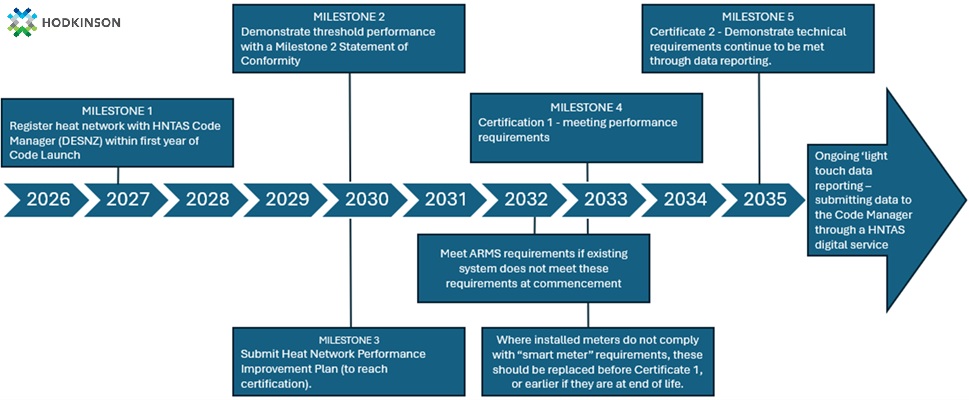
Figure 1 – Expected HNTAS compliance timeline for existing heat networks that are required to comply with the Heat Networks Metering and Billing Regulations2014 (HNMBR).
Posted on February 27th, 2026
Author: Carlyne Parillon