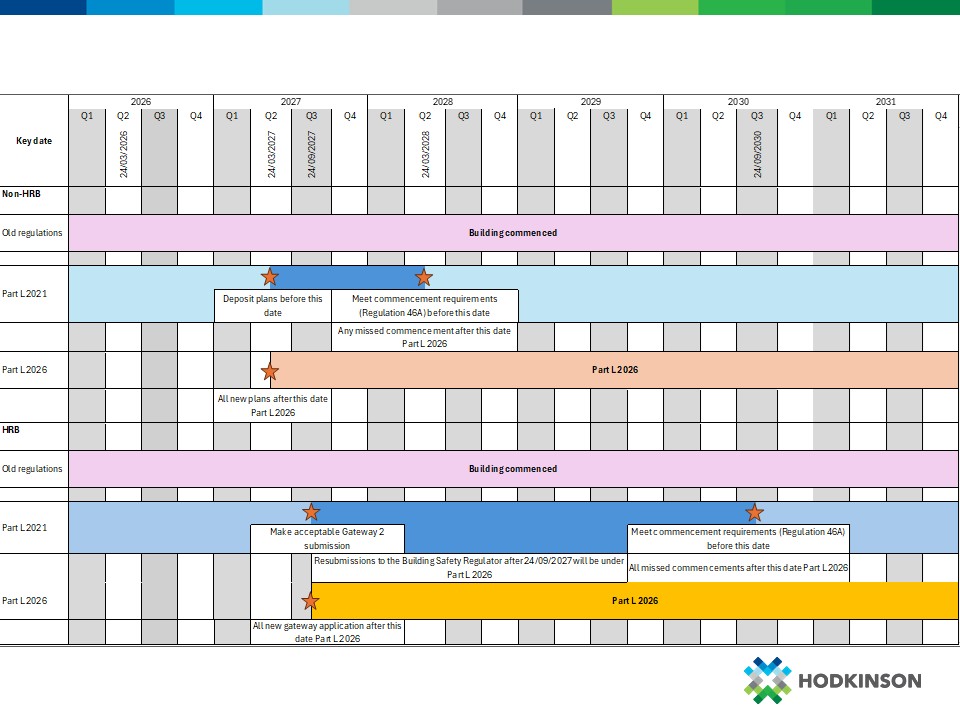
The Future Homes and Buildings Standards, now called Part L 2026, was laid in parliament on 24/03/2026 and presented some unexpected impacts:
- Part L 2021 remains in place for high-risk buildings (HRB) with commencements up to 24/09/2030 with successful gateway submissions by 24/09/2027. This substantial gap provides design teams an ability to make informed decisions for new projects. Further it will allow the new requirements of the Home Energy Model (HEM) to be understood, assuming it is published in the coming months as expected. HEM will replace SAP 10.3.
- SAP 10.3 reduces conflict between overheating and energy and removes winter solar gains benefits baked into Part L 2021 notional building.
- Exhaust Air Heat Pumps available today struggle to pass in SAP 10.3, however this may change in HEM.
- A pragmatic approach has been applied for connecting onto existing heat networks enabling both delayed plant installation and sleeving based on annual heat demand and not peak capacity.
- Communal heat networks (single building networks) are now generally discouraged with onerous targets in Part L 2026 and the incoming burden of HNTAS (Heat Network Technical Assurance Scheme) compliance and reporting.
In terms of some details:
Timeline
The government have provided two transition periods in recognition of building complexity. One for high-risk buildings that must follow the gateway process and one for those that don’t.
New requirements
- New functional requirements for PV for all dwellings
- The approved document provides a calculation for determining requirement which is based on a proportion of floor area and a PV panel efficiency threshold.
- There is a new functional requirement which requires providing fixed building services that minimise greenhouse gas emissions.
- The approved document discusses design, controls, commissioning and maintenance.
- Linked to above the approved document title has changed from conservation of fuel and power to energy and greenhouse gas emissions
- Could this be a gateway for future embodied carbon requirements?
Heat networks
The heat network parameters outlined in the Future Homes and Building Standard have improved the likelihood of connecting to area wide heat networks while increasing complexity of communal systems compliance :
- Area Wide Networks (providing both space heating and DHW)
-
- Performance standards for the notional building match heat network performance – providing no disadvantage but also no benefit over the notional building.
- Sleeving is acceptable and based on annual energy and not peak with 5 years after building completion to add capacity. Any temporary plant must also be ‘low carbon’.
- Heat networks do not need to be operating with 100% heat pumps but they must be low carbon.
- There are recognition future heat networks are to be legislated and controlled more
- Communal (within a block) networks
-
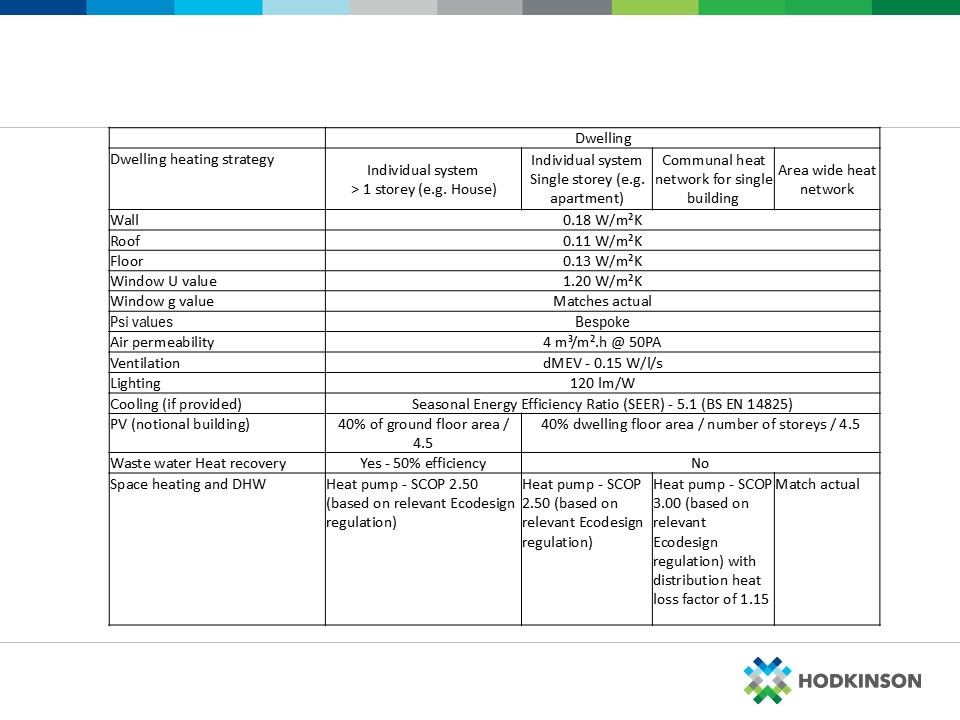
- 100% Heat pump, efficiency 300%, and distribution heat loss 1.15.
- Sleeving is not allowed.
- Temporary plant must be low carbon.
Ability to optimise designs
Compliance still requires meeting or surpassing the Notional Building’s CO2, primary energy and, for dwellings, fabric energy efficiency performances. This means that there are opportunities to add value to building design by balancing the notional building specification with performance limits in the Approved Document. The table below presents the performance metrics for the notional dwelling. The official documentation for the non-domestic building is limited to the Approved Document and not the equivalent notional building.
Assessment tools
There will be new software to determine compliance but have phased the complexity. Ensuring you start with the appropriate software will be critical to ensuring any targets beyond compliance are achieved.
- Initially SAP 10.3 an upgrade of the current version of SAP (10.2) will be available for use.
- The home energy model, or HEM, will be made available in a minimum of 3 months’ time, at some point after 24th June 2026. HEM is a dynamic calculation with many more proposed inputs over SAP.
- HEM and SAP 10.3 will operate together for 2 years.
- After 2 years of simultaneous operation SAP 10.3 will be expected to close and HEM continue.
Posted on March 31st, 2026
Author: Nikhil Doshi
Related services: SBEM (Non-domestic), SAP (Domestic), Energy & Fabric Performance Evaluation, Heat Network Performance Evaluation,